
The story behind the story
How a bedtime story came to life ten years later
The story behind Rose’s Halloween and the challenge of making good illustrations with AI
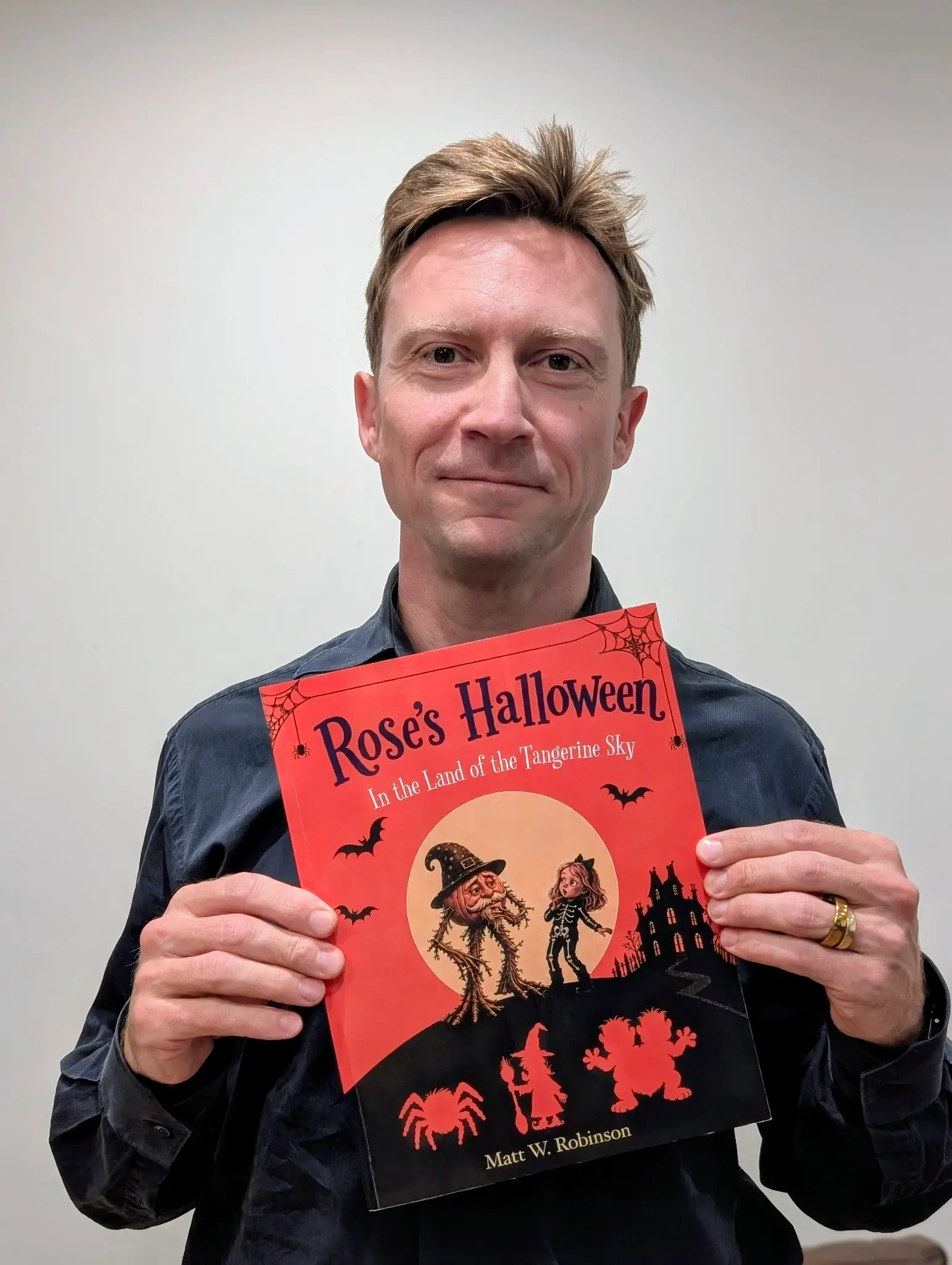
The idea for Rose’s Halloween was conceived in October 2016. I had been out trick-or-treating - primarily with my eldest son, an over-excited five-year-old and his two similarly aged cousins. A slightly perplexed two-year-old (my youngest son) was also in tow. My role on this jaunt seemed to involve two things: (i) preventing the kids from being run over; and (ii) making sure that they (particularly the five-year-old) said thank you after filling their pockets with as much sugary badness as they could lay their hands on. Which they, of course, almost unfailingly, would not (say thank you that is - laying their hands on sugary badness was no problem at all).
2016 - The Words
Back home, with everyone tired and overstimulated and me finally getting the kids into bed, I was accosted, as an alternative to the usual cosying up with a picture book to read together, by the dreaded request of tired minds to tell a “made-up story”. But, inspired by Halloween, I came up with a surprisingly good one involving Halloween decorations coming to life.
Ruminating on it that evening, I began combining the idea with my experience as a parent chasing after my greedy, ungrateful brats and saw how it could be developed into a story that might actually be useful as well as fun. Perhaps if we’d started priming the messaging a few days earlier by reading a story like the one that was to become Rose’s Halloween, their manners might have been (fractionally) better on the day.
The idea felt sufficiently good to spark an intensive two-month process where I set to work on the text, using my commutes and snippets of ‘free time’ during a busy family life to mull over the structure and potential lines of text. I always enjoyed reading rhyming picture books to my boys the most and that is what I wanted to create. Getting the right rhymes and rhythms to tell the right story - it was hard, but it was satisfying and eventually, I got the text to a state I was happy with. But I always knew that what the story needed was pictures. It was always written to be a picture book.
2026 - The Illustrations
Every year since 2016, one of my New Year’s resolutions has been to “find a way to get my Halloween story illustrated and published”. But a way to do it never fell from the sky and life always got in the way of me proactively pursuing it. In 2025 I tried using an AI image generator to see if it might be up to the task. It plainly was not. This year (2026) I tried again, aware that image generation models had been improving. However, this time it felt like it might be possible. Finally, it looked like I might be able to bring the book that had been sitting in my head and in a file on my computer, occasionally being read unsatisfyingly without pictures to my kids every Halloween, to life. I worked diligently on it for another couple of months trying to get the pictures right, trying to bring my vision for the book to the page. Having added a third child to the mix in the intervening years, it was once again a case of finding time where I could: evenings, ‘spare’ weekends and family holidays. I was not always popular with my wife and wider family! But I really wanted to see this thing made, ideally in time for Halloween.
Once I reached the point where I had a draft that I could share, I naturally sought feedback again from friends and family. But I was struck by the fact that some people disliked the images because they were AI-generated and I was interested in why that should be the case: if the images were good and helped tell the story, how much should the means by which they were produced matter? This question was the primary motive for me writing this piece as I think it is interesting to explore. I recently read a similar essay by the always exceptionally thoughtful and insightful Tomas Pueyo about Why People Don’t Like AI Content and How to Make it Great and I wanted to build on some of the ideas in there. I think there are some additional reasons, but let me start with those.
Shallow Intent
Tomas argues that the reason people don’t like AI art is because it often has what he calls ‘Shallow Intent’ - it may look good at first glance, but when you scratch below the surface it is superficial and lacks the depth of thought that a human would put into it. As such, we feel cheated because the output feels vacuous and unsatisfying. And at worst the depth of intent required is so badly misunderstood that the output simply misses the mark. I fully agree. In the process of creating Rose’s Halloween, I came across this problem a LOT.
To develop the book I had to start by developing a consistent visual style for the type of images I wanted to create: the style of illustration, the degree of photo-realism, the visual mood etc etc. Next I needed to develop a consistent look for each of the characters and props that appear throughout the story. The fact that AI could now do both of those things much more consistently than in the past gave me optimism that creating the book might be possible. However, my story also took place on a street with houses that appeared in more than one image. I needed the AI to understand that the houses needed to look identical - and this ideally meant down to the precise placement and design of all the elements of the house: the roof, the eaves, the windows, the doors, which side of the door the doorknob should be on, the placement of pumpkins outside the house and other objects in the visual scene. A human artist would intuitively and immediately understand the need for consistency, up to the human threshold of acceptance, across these minutiae. The AI image generator did not. This made creating images that could pass the ‘acceptability’ test for a book that required consistency from image to image very, VERY difficult. It was a bit like a game of whack-a-mole, with the moles representing the woeful image-generation problems or inconsistencies that kept popping up. Unlike in the real game, however, the rate at which they appeared gradually slowed as the prompt improved and more of the necessary elements of the scene became set in stone over repeated generations. Eventually they stopped popping up altogether. Or at least they went unnoticed for an acceptably long period of time.
AI Grime
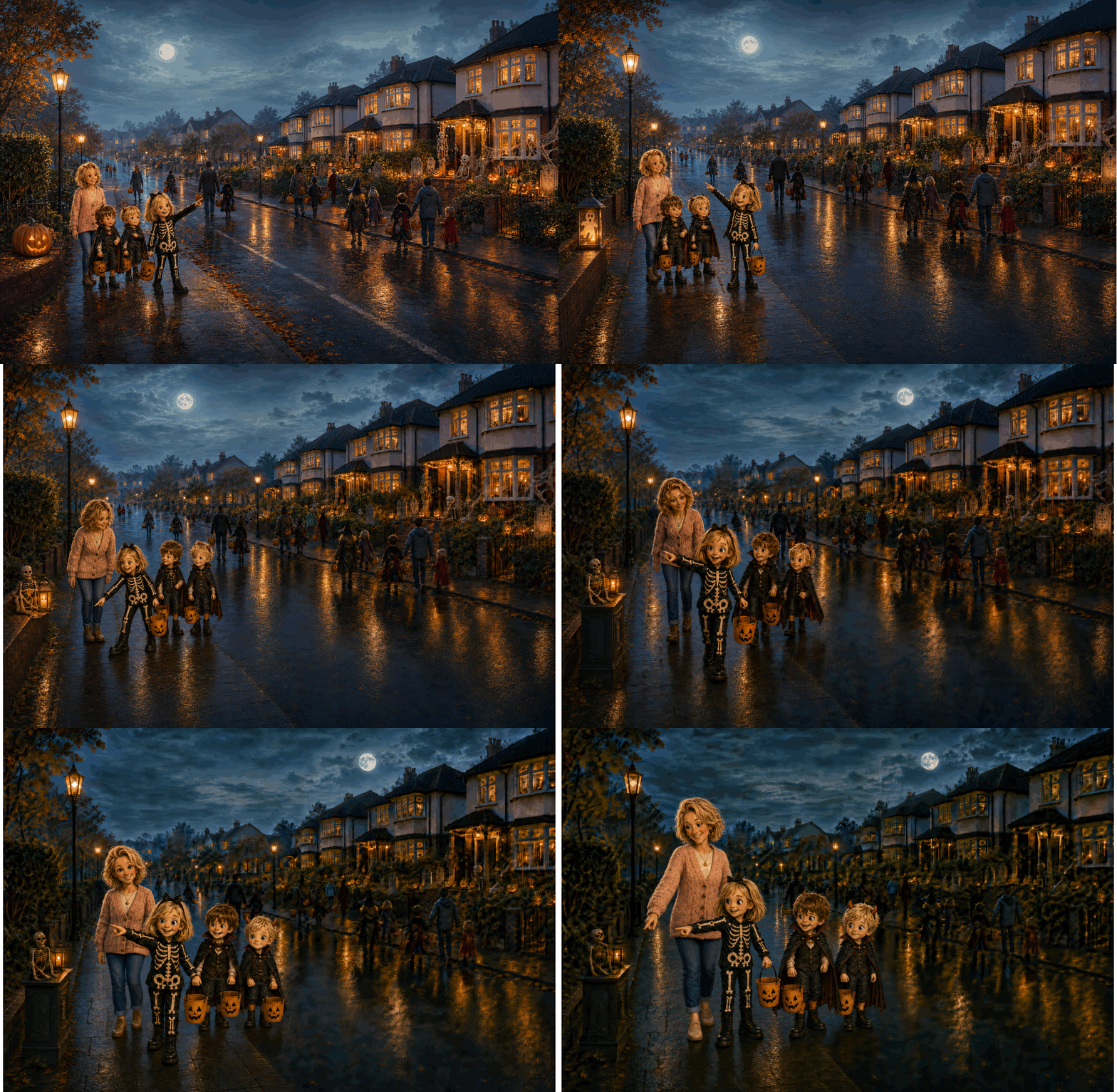
The game of whack-a-mole, however, made the other problem Tomas identifies extremely prevalent. The more I corrected and regenerated the same image over and over, the more the AI degraded its fine details to the point where they became a splodgy mess. The animation below shows how this happened to my first double-page spread as I repeatedly tried to get the characters correctly set in the scene.
Watch it once, focusing on the characters on the left-hand side. I worked hard to get the street designed the way I wanted with the characters positioned in the right place, pointing and looking in the right directions and correctly rendered to the character designs I had established. But when the animation loops back to the beginning, watch again with your eyes now focused on the Halloween decorations on the right-hand side of the image. They gradually dissolve into an increasingly dark, undefined splodge. I had happily thought I was making progress and then was dismayed to realise how polluted the image had become. Back to the drawing board! With enough work, I found it possible to reach a point where the scene was sufficiently well specified that I could start again with a fresh generation to remove the AI Grime, but it was always risky and frequently introduced new problems to correct. Back to the game of whack-a-mole!
Effort
This brings me to a third reason that I believe people don’t like AI content which is that they see it as ‘low effort’ work. It’s hard to value something that you think someone put no effort into creating. Whilst that sentiment is fair, it hinges on a lack of understanding as to how hard it is to create good AI content. And ultimately I think that is how a product should be judged: is it good, or not? To get the depth of intent right in the images I sought to create for Rose’s Halloween took a lot of effort, a lot of thinking, a lot of attention to the details and a LOT of iteration. Effort alone does not make something good, of course. But good AI-assisted work still requires someone to make hundreds of decisions about character, composition, continuity, atmosphere and what belongs in the image - and, just as importantly, what does not. You can resolve the problems of Shallow Intent and AI Grime and produce an image that looks good, reflects what you as an ‘AI artist’ were trying to create and is something you are happy to put your name to, but it is not an easy task and it takes a lot of human time and input.
Displacement
Obviously another fear of AI is that it is going to take jobs and this is another reason people may dislike AI content. In the case of an illustrated book, it is a physical manifestation of that fear. Some of this fear rests on an assumption that creativity is a zero-sum game: that AI doing work is always displacing work that a human would otherwise have done. But that is not necessarily the case.
Rose’s Halloween is a good example of this. The book sat on my hard drive for ten years and, if AI had not come along, that is where it would have stayed. I was never realistically going to be able to commission an illustrator, and the chances of finding someone willing to sink so much time into making it as a side project with an unpublished author were slim. I also wanted a degree of creative control that would have required an unusually close partnership. So, in this particular case, no illustration commission was displaced.
This does not dispose of the wider and legitimate concerns about illustrators’ livelihoods, the material used to train AI models or the effect these tools may have on the creative industries. But it does complicate the idea that every AI-assisted creation represents a piece of human work that would otherwise have been commissioned. Instead, in this case, AI has made it possible for me to create something that would not otherwise have been made. To me, this is a tangible example of the more optimistic view of the economic impact of AI: by fuelling new ideas, creations and entrepreneurship, it has the potential to improve productivity, enable us to make more good things and leave us better off.
But Did I Make It “Good”?
As I understand it, Tomas Pueyo’s argument is that, to be good, AI art needs to be beautiful but it also needs to be free of Shallow Intent and AI Grime. And in this piece I argue that a product should be judged principally on whether it is good or not, not solely on whether or not it was produced using AI. I think that, with effort, I was able to solve at least some of the Shallow Intent and AI Grime issues in the production of Rose’s Halloween. But whether the artwork is beautiful and whether it is ‘good’ is ultimately for others to decide. Personally, I like the illustrations and I like the characters and I like that I was able to get very close to producing the vision for the story that was in my head when I wrote the words. But others may not like them. Some people may simply think the illustrations in Rose’s Halloween are not good. And that is totally fair enough.
To Conclude
I don’t think any of this means that AI-generated imagery is the same as traditional illustration, and I don’t think people are wrong to value the work of human illustrators differently. But I do think AI can help people make things that otherwise would never exist. Whether the result is worthwhile still depends, at least for now, on the thought, judgement and care that a human being puts into it.
People may also have wider concerns about AI: its environmental impact or Terminator-style existential threats. Topics too big for this little blog post. No doubt AI creates challenges, but it also creates opportunities. It may use a lot of energy, but it may also help us find clever new ways to generate cleaner energy and combat climate change. And it may get super powerful and decide to kill us all. But until that happens, we may as well cuddle up with our kids with a nice story while we still can.